
Every product accumulates features; good products have a place where features prove themselves first. Ours is the Hangar — mdpilot.in/labs — where experiments ship early, get measured honestly, and either graduate to the main deck or get retired without ceremony.
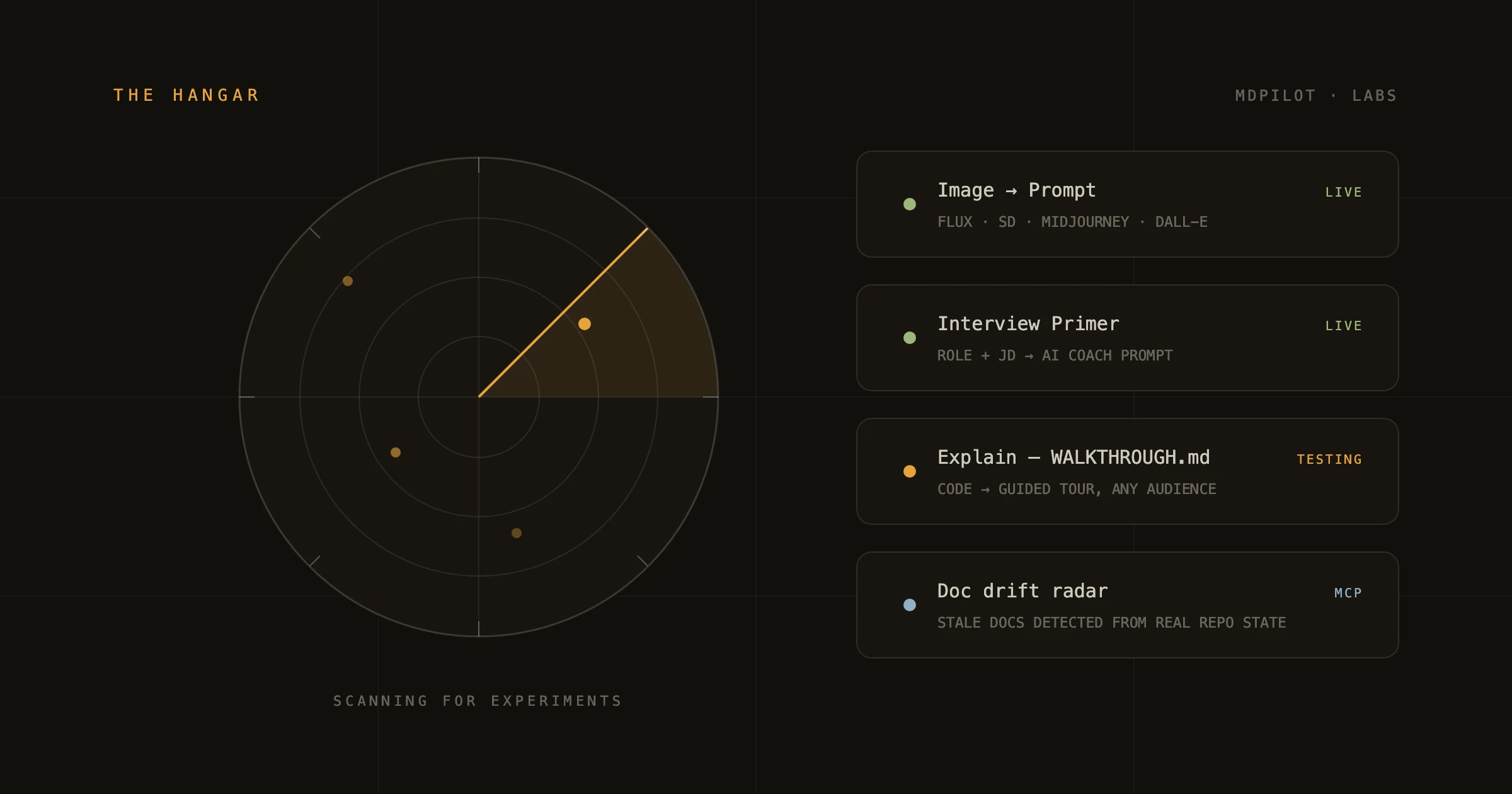
Image → Prompt
Paste any image and get a recreation prompt engineered for your target generator — FLUX, Stable Diffusion, Midjourney, DALL-E, or Gemini. Each target gets different output, because each model wants prompts in a different dialect: Midjourney rewards comma-packed style stacks, FLUX prefers full sentences, SD wants weighted keywords.
The interesting engineering problem isn't describing the image — vision models do that well. It's describing it in the *idiom of the target model*, which is a translation problem layered on a perception problem.
Interview Primer
Role plus level plus job description in; a ready-to-paste AI coach prompt out. Paste it into any chat model and it becomes a focused interviewer for that exact role — asking calibrated questions, pushing on weak answers, staying in character. It's the Task mode idea pointed at a different problem: the value is in the structured first message.
Explain — WALKTHROUGH.md
Point it at a file or directory and get a guided walkthrough tuned to a chosen audience — new team member, non-technical stakeholder, code reviewer, or future-you. Same code, four very different documents. Currently in testing: directory-level walkthroughs that trace data flow across files rather than explaining each file in isolation.
The MCP side of the Hangar
Some experiments live in the mdpilot-mcp server rather than the website, because they need your real repo on disk. The drift radar (check_drift) compares your docs against actual repo state — broken commands, paths that no longer exist, MCP servers that were removed — and update_docs patches only the stale sections. Session memory (save_context / load_context) persists decisions across conversations, locally, with secrets redacted.
How experiments graduate
The learning loop decides. Anonymous usage events show which tools get reached for twice; thumbs-up ratings with kept-unedited outputs feed a nightly job that promotes the best generations into gold examples — few-shot anchors that make the next generation better. An experiment that accumulates gold examples is earning its place. One that doesn't is telling us something too.